Limits of Knowledge and Observation
The Blazing WorldLimits of Knowledge and Observation names a central tension in The Blazing-World: nature presents more variety than any observer can perceive or explain, and instruments that promise to extend knowledge may multiply disagreement rather than settle it. In her inquiries among the learned societies, the Empress repeatedly distinguishes an observed appearance from the explanation attached to it, testing both against the limits of sense and reason. The result is not a simple rejection of experiment, but a sustained account of what observation can disclose, what it leaves unsettled, and what no material instrument can reach.
Perception and Nature’s Variety
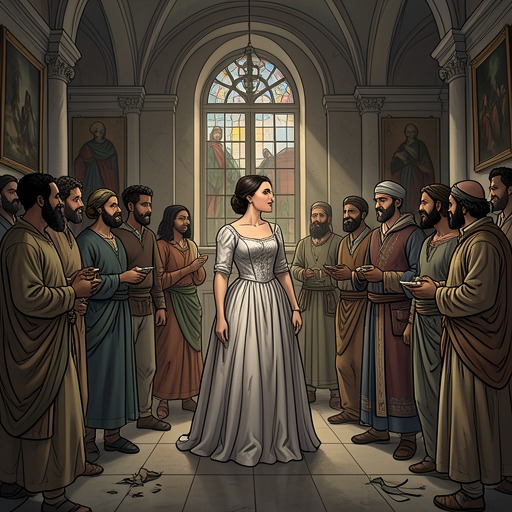
The Empress’s questions to the Bird-men establish the problem before instruments enter the discussion. Asked what substance the air is, they answer that they perceive it only through respiration. Some bodies, they explain, are accessible to touch, others to sight or smell, while some escape the exterior senses altogether. Nature is so various that human sensory powers cannot register all its creatures, and no single object need be perceptible to every sense. Their answer makes ignorance a consequence of the limits of perception, not proof that what cannot be perceived does not exist.
Wind offers a harder test. The Bird-men can report that it seems denser than air and can be felt, but cannot agree on its cause. They propose clouds colliding, a hot and dry exhalation driven down from the middle region, flowing water in the air, or air moved by the blaze of the stars. These proposals do not arise from a settled observation of the mechanism: the same perceptible phenomenon supports incompatible accounts. The Empress moves on to snow, and an account based on water mixed with an extract of elemental fire unsettles her prior belief that snow results from cold motions. Further observations by other societies partly confirm the Bird-men, while leaving the causal explanation under examination. Knowledge develops here through comparison, but comparison does not automatically end uncertainty.
Telescopes and Disputed Appearances
The Empress summons the Bird-men to report on the Sun and Moon, then asks what other stars they can perceive. They describe the Sun as a vast, yellowish, solid stone and the Moon as a shining body with light of its own; they also disagree about the source of the Sun’s heat. Their report joins description to conjecture: what they can see does not settle what the celestial bodies are or how their properties arise. When they identify the world’s other visible stars as blazing stars of varied shapes, including some with tails, the limits of their account remain implicit in the restricted field of what they can perceive.
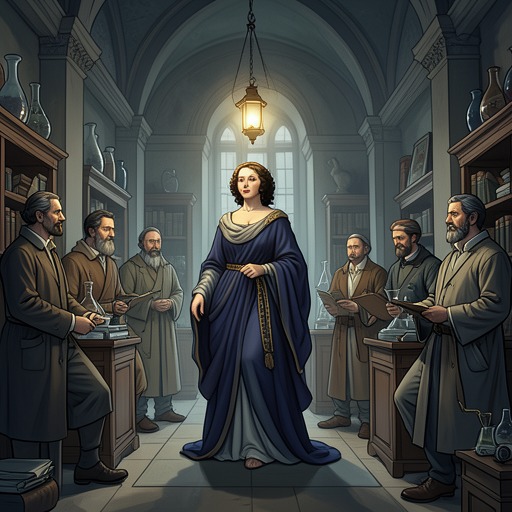
To improve celestial observation, the Empress orders the Bear-men, her Experimental Philosophers, to examine the heavens through Telescopes. The instruments yield more claims, but not a shared account. Some observers say that the Sun stands still and the Earth moves around it; others say both move, while another group holds that the Earth stands still and the Sun moves. The observers also differ over the number and size of stars, report discovering new ones, and dispute whether the Moon’s spots are hills and valleys or terrestrial parts surrounded by seas. The Telescope extends the field of visible evidence, but the observers’ interpretations do not converge.
The disagreement becomes especially pointed when the Bear-men report three blazing stars at the end of the Pole adjoining the world from which the Empress came: two bright and one dim, appearing one after another in a short time. Some say these were three distinct stars. Others argue that a single star appeared at three times and places, citing the differing positions, the short interval, the absence of visible motion across the vast distance, and the unequal brightness. The same instrumental observations thus support rival explanations, and the Empress grows angry that the Telescopes have failed to provide reliable intelligence. She calls the glasses false informers and orders them broken, insisting that celestial bodies should instead be examined through natural eyes, sense, and reason.
The Bear-men resist the Empress’s verdict. They attribute disagreement not to defective glasses but to differences in the observers’ sensitive motions and irregular judgments. The Empress counters that true instruments should correct irregular perception and argues that Nature has made sense and reason more regular than Art has made the glasses. Their dispute exposes a gap between seeing through an instrument and knowing what the sight means: neither the instrument’s advocates nor its critic can make the contested appearances self-interpreting. The Bear-men plead to keep their Telescopes because artificial delusions give them pleasure, provide subjects for argument, and preserve opportunities to distinguish one observer’s supposed wisdom from another’s. The Empress finally allows them to remain on condition that their quarrels stay within their schools and do not produce factions or disturb the state. The instruments survive, while their claims are politically contained rather than resolved.
Microscopes: Enlargement Without Certainty
The Bear-men next present Microscopes, which enlarge small bodies until a louse can seem as large as an elephant and a mite as large as a whale. Their report on a drone-fly is strikingly precise: its head and much of its face consist of two great clusters covered with polished, pearl-like hemispheres, arranged in a triangular order and numbering 14,000. The observers infer that each hemisphere is an eye because they perceive a transparent cornea and a liquid resembling the humors of an eye. The Empress offers a competing possibility: the structures might be glassy pearls rather than eyes, and the Microscopes might not inform them truly. The instrument makes minute structure visible, but the step from appearance to biological function remains disputable.
The Bear-men claim that Microscopes, unlike Telescopes, correct and inform the senses, and that the world would remain blind without them. Their confidence is tested by further observations. Looking at charcoal, they count 2,700 pores along a line an inch long and conclude that the pores cause its blackness because they reflect no light. The Empress points out a contradiction in their reasoning: if all colors result from the reflection of light and black is as much a color as any other, black cannot at the same time be explained as an absence of reflection. Looking at a nettle, the observers identify small poison-filled bladders beneath its points and describe the points as syringe-pipes that convey the liquid into the skin. Asked why nettles do not cause internal harm when eaten, they reply that explaining effects belongs to physicians, whereas their own task is to inspect and report the shapes of natural parts. The episode distinguishes close description from a complete causal account: the specialists’ observations do not, by themselves, answer every question the Empress asks.
Microscopic enlargement also exposes a practical limit. The Bear-men’s strongest instrument cannot encompass a whale’s full shape; the narrator cannot determine whether the failure lies in the glass or in the whale’s position relative to reflected light. Reversing the operation, the Bear-men make contracting glasses: through them a whale appears no larger than a sprat, sometimes no larger than a vinegar eel; an elephant can seem the size of a flea, and a camel the size of a louse. Yet even such skill cannot produce glasses that reveal a vacuum in all its dimensions, immaterial substances, non-beings, or beings between something and nothing. The observers hope that study may eventually overcome this boundary, but the account leaves their hope unfulfilled. Instrumental reach can be enlarged or reversed without becoming unlimited.
Knowledge Beyond the Instruments
The limits under examination are not confined to optical instruments. When asked about animal perception, the Fish-men and Worm-men admit that different creatures may have different perceptions and organs beyond what human senses can discover. They offer one particular observation: in an oyster, the common sensorium seems to lie at the closing of the shells, where pressure and reaction can be noticed as the shells open and shut with each tide. It is a suggestive inference grounded in visible movement, not a general account of animal sensation. The example returns the inquiry to its governing difficulty: the evidence available to an observer need not disclose the full experience or organization of another kind of creature.
The Immaterial Spirits likewise refuse to turn difficult concepts into knowledge merely by naming them. Asked to explain the Platonists’ three principles of a human being—the Intellect, Spirit, or Divine Light; the Soul itself; and the Image of the Soul, its vital operation on the body—they say they do not understand the distinctions. To sense and reason, the terms seem like three bodies or three bodily actions, and the Spirits characterize them as intricate conceptions of irregular fancies. They add that philosophers who attempt to go beyond sense and reason commit absurdities: no corporeal creature, they say, can pass beyond those limits, not even Spirits while they remain in corporeal vehicles. The exchange extends the book’s epistemological caution from insufficient instruments to speculative systems that claim to exceed the conditions under which understanding operates.
The Empress’s Standard and Its Tensions
The Empress gives this skepticism a philosophical foundation in her address to the Ape-men, who have disputed the principles of natural bodies through chemical experiments. She argues that Nature is one infinite, self-moving body, divided into infinite parts that continually change through composition and division. Since matter’s self-motion is the universal principle and cause of natural effects, she considers it futile to search for primary ingredients by treating particular effects of Nature as ultimate principles. Fire, she says, cannot reveal the foundations of nature: it affects different bodies differently and cannot change gold’s interior figure. She directs the Ape-men away from such fruitless attempts and toward experiments beneficial to the public. Her standard therefore joins an account of nature to a judgment about inquiry: experiments should not mistake a limited operation for access to an ultimate principle, and their use should have practical value.
Yet the narrative does not make the Empress’s confidence a simple solution to every uncertainty. In the Telescope dispute, she treats natural eyes and regular reason as superior to artificial glasses; in the microscope episodes, the Bear-men insist that the instruments rectify perception, while the Empress herself questions what their images prove. Nor do the societies’ uncertainties disappear when she sets aside a claim: her preferred account of a phenomenon is not always demonstrated conclusively by the observations presented. The recurring contrast is instead between evidence and inference, between a device’s power to make something visible and the observer’s power to interpret it. By allowing the Telescopes to remain under restrictions, the Empress also acknowledges that disputation has attractions and uses, even as she refuses to let it govern the state.
Across celestial reports, microscopic inspections, animal perception, and philosophical speculation, Limits of Knowledge and Observation defines knowledge as real but bounded. The learned societies can describe appearances with precision, compare competing causes, and reveal structures previously unseen; they cannot always agree on what those appearances mean, explain every consequence, or reach immaterial and other inaccessible objects. The Empress’s repeated questioning makes those gaps visible. What remains uncertain is not simply a failure of diligence: it is the distance between nature’s variety and any finite observer’s means of knowing it.